Monday, January 11, 2010

Clockmender

Norman Rockwell immortalized the store’s clocks in a typically whimsical illustration for the cover of the wildly popular Saturday Evening Post on Nov. 3, 1945:
The clock depicted is the Randolph St. clock, as evidenced by the Oriental Theater sign partially visible in the background.
Like other Rockwell paintings, this image presents a sentimental snapshot of American life – the working-man clockmender whose simple pocket watch establishes the time for a grand clock whose immense size literally dwarfs him (in reality, the clocks were set inside the store).
By using Marshall Field’s clock, Rockwell helped cement the store’s status as an iconic symbol of both grandeur and typical American-ness. Rockwell donated the painting to the store in 1948.
Macy’s later donated it to the Chicago History Museum, sealing its status, in turn, as an icon of Chicago history.

Thursday, January 7, 2010

The cathedral of all stores

There has been a lot written about how department stores often emulated church architecture. At least as early as 1922, the store's "new" buildings were referred to as the "Cathedral of all Stores."

But what does this really mean? Just that they were really big and impressive?

Well, yes, that's part of it. Department stores certainly wanted to claim for themselves many of the characteristics that made churches so dominant in society.

Consider, for example, the nave - the long wide aisle that served as a cathedral's principal architectural detail.

Interior of the Basilica di San Lorenzo di Firenze, Florence, looking towards the high altar. Photo taken by Necrothesp, 20 May 2004.

The nave serves a number of functions in a cathedral, but for our purposes, a key feature is to emphasize the building's length. The impressive pillars add to the illusion, drawng your eye down the long expanse.

Now compare the photo above to this: Hmm? Look slightly familiar. Granted, here we're not being urged to look towards anything -- certainly nothing as spectacular as a sanctuary. At the end of this particular aisle is the door exiting onto Washington St.

But whether we realize it or not, as shoppers the architecture is doing to us the same thing it does for a cathdral -- emphasizing for us a sweeping, dramatic expanse of space. Giving us a sense of awe and wonder. Creating an emotional reaction that identifies this space as a special space set aside from the tawdry, everyday world.

OK, perhaps I'm getting carried away. We could go on to some silly lengths (ever notice that the main entrance to Field's was placed on the west -- just as it is in cathedrals? Well, ok, so that's where State St. just happens to be, but stil ...)

Still, it's worth noting the common desire among cathedral and department store architects to design spaces with a feeling of awe, splendor, and ritual.

And perhaps therefore not a coincidence at all that just as cathedrals had spurred on and used some of the most impressive technological and artistic achievements of their day, department stores pushed for and made extensive use of amazing new technological achivements innovations.

All you have to do is look at the large expanses of plate glass in a department store display windows dating from the early 20 century to see that.

Wednesday, December 16, 2009

Marshall Field's delivery wagons

One of the most common memories of Marshall Field's must be its delivery trucks. Those gorgeous green trucks coming up the street with fabulous goodies inside. By the end, these were used for furniture and not a whole lot else. But for decades the store would delivery anything from a new refrigerator to a spool of thread.


What is probably barely remembered today is that during much of the heyday of the store's delivery service, horse-drawn wagons were used:


In those days, it was not unknown for retailers to whip horses and flog them, sometimes even to death. According to Give the Lady What She Wants, Field had different ideas. He made cruelty to horses grounds for dismissal. On the very hottest days, horses had to rest (young boys strapped packages to their backs instead). Horses only worked half a day, even if that meant a driver had to leave his horse at a neighborhood stable and go back for another horse so he could finish his deliveries.

I would love to locate a photograph of signs in the Marshall Field's barns that read “Don’t whip the horses!”

Thursday, December 10, 2009

Advertising the toy dept

One of the quintessential Marshall Field's moves, at least in the days during and soon after its founder's leadership, was an insistence on service.

It's fascinating to see how this ideal extended even to advertising. Like in this postcard:

Notice that it does not extol how extensive their toy selection it (it was -- at one time among the largest in the U.S., if not the largest) or how diverse (anything from a single balloon to a custom-made bicycle or how rare (one-of-a-kind handpainted toy soldiers anyone?)

No, it's an educational blurb about the value of toys in a child's growth and development. About how important they are in developing breadth and activity. A little lesson in how much Field's cares about that.

I'm not saying there's anything false here. On the contrary. One of the special things about the store was its consistent striving to show that it went above and beyond to provide the ultimate in service. Yes, sure, they're out to make a profit, but they almost make it sound like that's not really their main goal.

Note that even the central image is not really about the toys (that's reserved for the surprisingly detailed border illustrations), but rather of the children playing. And of course developing as they do so.

That is just SO Marshall Field's.

Wednesday, November 18, 2009

The Crystal Palace


Just came upon this priceless ad from, I believe, 1974:
Anyone remember getting ice cream at the Crystal Palace? It wasn't on the 7th floor with the other restaurants, but on 3.

Come to think of it, I remember getting ice cream at the Oakbrook Center Field's store, in a place they called "Strawberry Fields," which had an all-strawberry theme: strawberry ice cream, strawberry-decorated cookies, chocolate-covered strawberries. It didn't last long, but I was enchanted with the idea, and the strawberry-printed tiles on the walls.

Tuesday, November 3, 2009

Oooo boy my mother is going to be maaaaad

When I started researching Field's history, I figured, hey, I probably have a ton of photos of Field's. Definitely of the Walnut Room Christmas tree.

My family -- well, my three adorable nieces, my darling mother, my lovely sister and I -- have been going to the Walnut Room for at least 10 years now. Like everyone else, we wait around forever (well, unless my mother does the saintly thing and goes early to get us one of those buzzer things). One year we arrived around lunch hour and waited so long the girls resorted to stuffing themselves on potato chips and it was probably closer to 4 when we finally sat down for "lunch." The next year, we arrived so early we got seated at something like 10 a.m. These things just cannot be coordinated.

Nope. Two hours of digging through boxes of photos turned up exactly one out of focus photograph that doesn't include me:
My mother (who will hate me because she hates seeing photos of herself but I think she looks great) and my darling niece Annie.
Blurry? Check. No visuals of the background? Check. So tightly cropped it could be in any restaurant and we can only tell it's the Walnut Room because of the date marked stamped on it? Check check check.

Why is it that I take tons of photos of things I never want to look at in the future -- acquaintances from high school who happened to be at the graduation ceremony, buildings at college that I can no longer even recall what went on in them, every unflattering Halloween costume ever worn -- but the things that now really form cherished memories some elude photographic immortalization?

But these great traditions that we look forward to every year? Not nearly enough photos.

So, goal for the future: Take more photos. Of the things that really matter.


Monday, November 2, 2009

Top 10 Favorite Marshall Field's Traditions


One of the delights of exploring department store history is learning which traditions are most cherished by customers and employees.

In talking with people and reviewing books and articles about Marshall Field’s, certain favorite traditions emerge as the standouts. In my unscientific assembling, the top 10 favorite traditions are:


10. Uncle Mistletoe. What's not to love about a Christmas character who looked like he stepped right out of a Dickens novel, encourages kids to join the Kindness Club, and has eyebrows that resemble small boats?


9. Marshall Field's Special Sandwich. A huge hunk of iceberg lettuce, some chicken and neon Thousand Island Dressing. A Classic, even if hasn't appeared on a menu for years.


8. The 3rd floor book department. This is the dept. that

started book signings and hosted everyone from Shirley Temple to Admiral Byrd to Amelia Earhart. For a while, the biggest book dept. in the world (or so Field's always said)


7. The 8th floor Trend House. A ground-breaking idea for its time -- an entire house set up on the 8th floor, changed about twice a year and featuring fully decorated rooms. Originally the furnishings were affordable and the looks something ordinary people might want, but gradually it drifted into the outrageously trendy and outrageously pricey.


6. The 4th floor children's dept, especially the toy and game dept. At one time, the largest toy dept in the world (again, in Field's own unbiased words) and full of exclusives, like Field's own Madame Alexander dolls and Marshall Field's green Tonka trunks.


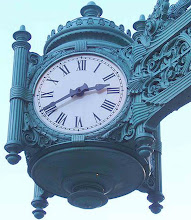
5. The Great Clock. According to legend, established so people would have a convenient place to meet. The original clock at State and Washington was replaced when the new store building went up. And a mate was installed at State and Wabash (in the new building that actually opened prior to the one at State and Washington). Designed by Daniel Burnham's firm, which also did the building, and slated for memoralization in a Saturday Evening Post cover by Norman Rockwell. For some reason, the clock at Washington St. became more famous than the one at Wabash -- and both more famous than virtually any other clock in Chicago.


4. The Tiffany mosaic glass dome. Still the largest individual piece of irridescent glass mosaic ever installed. When it opened, as part of the new building's opening in 1907, president John G. Shedd worried that the floor under the dome might not hold up under the weight of the throngs who came to see the dome.


3. Frango mints. Chocolate. Mint. Delicious. Not a Field's original (acquired with the acquisition of the legendary Frederick and Nelso Dept. store in 1929) but Field's made it its own, producing it for years on the flagship store's 13th floor. Field's perpetuated the wonderful legend that they were originally called Franco's but were renamed when the Spanish dictator rose to power. Sadly, patent application papers reveal that the name Frango was registered in 1918, long before anyone heard of Generalissimo Franco.


2. The Great Tree in the Walnut Room. Originally a 45-foot real tree hauled up the light well and monitored by firefighters, but for most of its history an artificial -- but splendid tree rising several stories high. Eating lunch or having tea under the Great Tree became such a tradition for Chicago families that many children's memories include the hours and hours -- and hours -- of waiting until a table openedup.

1. The Christmas holiday windows. Marshall Field's was not the first department store to put up Christmas window displays, but like so many other things, the Field's windows came to feel like the best in Chicago.


Ok, maybe nothing earth-shattering here, but think about this:


On this list, 5 of the 10 are not directly related to buying. The Christmas windows, the Tiffany dome, the Great Clocks -- not things you came to purchase, but rather the delightful, lavish displays that drew you to the store and made experiencing it a one-of-a-kind, special indulgence. They marked a visit to the store as something opulent and luxurious. They were part of the “feel” of the store, the emotional whallop a visit to it delivered.