Ever take your kids to see the Marshall Field's Christmas windows? Or eat in the Walnut Room or get a makeover at the cosmetics counter?
I'm in search of personal photographs of Marshall Field's Department Store, especially the State St store, for an upcoming illustrated history of the fabled department store. The book, titled Remembering Marshall Field's, is slated for publication in April 2011.
All photographs are welcome, but especially these:
-- Photographs that show any departments of the store, even just in the background (for example, customers trying on a wedding gown in the bridal salon, school clothes shopping, trying on hats with friends, getting make-up tips, etc.)
-- Photographs of kids visiting Field's Santa
-- Photographs taken at a special event at the store, such as a booksigning, the Christmas decorations, the lightwell flag, a visit from a celebrity promoting some new merchandise, etc.)
-- Photographs showing behind-the-scenes (for example, employees eating in the employees lunchroom, stocking inventory, working the telephones, making candy)
-- Photographs from any decade are welcome. I am especially in need of photographs from the 1960s, 1970s, 1980s, and 1990s.
Photographs must be those that I can obtain permission to republish (such as something you took yourself) and I'll need to either be able to borrow it for a short while to scan it or obtain a high-resolution scan of it. Photographs must be received by me no later than August 31, 2010.
Yes, there are official photographs taken by store photographers and many of those will be included in the book. But it is the snapshots from the people who knew and loved the store that I'm interested in, the personal ones that could make this book something to treasure.
This is a wonderful way to preserve and honor this grande dame of department stores. Take a minute to look in your photograph albums and consider sharing your share memories with others.
Friday, February 12, 2010


Sunday, January 17, 2010
Marshall Field's and the Field Museum
Yes, their names are similar: Marshall Field, Field Museum.
But beyond just the assumption that he gave a lot of many, how many modern Chicagoans actually know the link between Marshall Field and the museum that bears his name?
The founding of a museum to house biological and anthropolical specimens predates any involvement of Field. The museum came about because people felt there was a need to save and preserve collections assembled for Chicago's World's Columbian Exposition in 1893. Those collections -- which formed the core of what later grew into a much larger collection -- were at the center of a new museum incorporated on Sept. 16, 1893 as the Columbian Museum of Chicago. And it was housed, logically enough, in Jackson Park, where the Columbian Exposition had been.

The building chosen was also the logical one -- the building erected as the Palace of Fine Arts. While it had a glistening plaster facade like many other buildings put up for the Fair, its costly art contents demanded greater protection and strength. So it was the only Fair structure built of brick, given it a permanence that virtually all the other fair buildings lacked.
Not until 1905 did the museum's name change to honor Chicago's retail giant. As the museum's first large-scale benefactor, Marshall Field won the honor of seeing the museum changed to the Field Museum of Natural History.
The museum stayed in Jackson Park until 1921, when it moved to its present site on what is now known as the Museum Campus.

When the Field Museum left Jackson Park, the former Palace of Fine Arts was eventually transformed into the home of the Museum of Science and Industry.
Monday, January 11, 2010
Clockmender
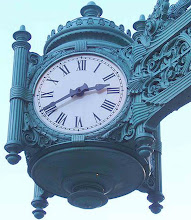
Norman Rockwell immortalized the store’s clocks in a typically whimsical illustration for the cover of the wildly popular Saturday Evening Post on Nov. 3, 1945:

The clock depicted is the Randolph St. clock, as evidenced by the Oriental Theater sign partially visible in the background.
Like other Rockwell paintings, this image presents a sentimental snapshot of American life – the working-man clockmender whose simple pocket watch establishes the time for a grand clock whose immense size literally dwarfs him (in reality, the clocks were set inside the store).
By using Marshall Field’s clock, Rockwell helped cement the store’s status as an iconic symbol of both grandeur and typical American-ness. Rockwell donated the painting to the store in 1948.
Macy’s later donated it to the Chicago History Museum, sealing its status, in turn, as an icon of Chicago history.
Thursday, January 7, 2010
The cathedral of all stores
There has been a lot written about how department stores often emulated church architecture. At least as early as 1922, the store's "new" buildings were referred to as the "Cathedral of all Stores."
But what does this really mean? Just that they were really big and impressive?
Well, yes, that's part of it. Department stores certainly wanted to claim for themselves many of the characteristics that made churches so dominant in society.
Consider, for example, the nave - the long wide aisle that served as a cathedral's principal architectural detail.
Interior of the Basilica di San Lorenzo di Firenze, Florence, looking towards the high altar. Photo taken by Necrothesp, 20 May 2004.
The nave serves a number of functions in a cathedral, but for our purposes, a key feature is to emphasize the building's length. The impressive pillars add to the illusion, drawng your eye down the long expanse.
Now compare the photo above to this: Hmm? Look slightly familiar. Granted, here we're not being urged to look towards anything -- certainly nothing as spectacular as a sanctuary. At the end of this particular aisle is the door exiting onto Washington St.
But whether we realize it or not, as shoppers the architecture is doing to us the same thing it does for a cathdral -- emphasizing for us a sweeping, dramatic expanse of space. Giving us a sense of awe and wonder. Creating an emotional reaction that identifies this space as a special space set aside from the tawdry, everyday world.
OK, perhaps I'm getting carried away. We could go on to some silly lengths (ever notice that the main entrance to Field's was placed on the west -- just as it is in cathedrals? Well, ok, so that's where State St. just happens to be, but stil ...)
Still, it's worth noting the common desire among cathedral and department store architects to design spaces with a feeling of awe, splendor, and ritual.
And perhaps therefore not a coincidence at all that just as cathedrals had spurred on and used some of the most impressive technological and artistic achievements of their day, department stores pushed for and made extensive use of amazing new technological achivements innovations.
All you have to do is look at the large expanses of plate glass in a department store display windows dating from the early 20 century to see that.
But what does this really mean? Just that they were really big and impressive?
Well, yes, that's part of it. Department stores certainly wanted to claim for themselves many of the characteristics that made churches so dominant in society.
Consider, for example, the nave - the long wide aisle that served as a cathedral's principal architectural detail.
Interior of the Basilica di San Lorenzo di Firenze, Florence, looking towards the high altar. Photo taken by Necrothesp, 20 May 2004.
The nave serves a number of functions in a cathedral, but for our purposes, a key feature is to emphasize the building's length. The impressive pillars add to the illusion, drawng your eye down the long expanse.
Now compare the photo above to this:
Hmm? Look slightly familiar. Granted, here we're not being urged to look towards anything -- certainly nothing as spectacular as a sanctuary. At the end of this particular aisle is the door exiting onto Washington St.But whether we realize it or not, as shoppers the architecture is doing to us the same thing it does for a cathdral -- emphasizing for us a sweeping, dramatic expanse of space. Giving us a sense of awe and wonder. Creating an emotional reaction that identifies this space as a special space set aside from the tawdry, everyday world.
OK, perhaps I'm getting carried away. We could go on to some silly lengths (ever notice that the main entrance to Field's was placed on the west -- just as it is in cathedrals? Well, ok, so that's where State St. just happens to be, but stil ...)
Still, it's worth noting the common desire among cathedral and department store architects to design spaces with a feeling of awe, splendor, and ritual.
And perhaps therefore not a coincidence at all that just as cathedrals had spurred on and used some of the most impressive technological and artistic achievements of their day, department stores pushed for and made extensive use of amazing new technological achivements innovations.
All you have to do is look at the large expanses of plate glass in a department store display windows dating from the early 20 century to see that.
Wednesday, December 16, 2009
Marshall Field's delivery wagons
One of the most common memories of Marshall Field's must be its delivery trucks. Those gorgeous green trucks coming up the street with fabulous goodies inside. By the end, these were used for furniture and not a whole lot else. But for decades the store would delivery anything from a new refrigerator to a spool of thread.
What is probably barely remembered today is that during much of the heyday of the store's delivery service, horse-drawn wagons were used:
What is probably barely remembered today is that during much of the heyday of the store's delivery service, horse-drawn wagons were used:

In those days, it was not unknown for retailers to whip horses and flog them, sometimes even to death. According to Give the Lady What She Wants, Field had different ideas. He made cruelty to horses grounds for dismissal. On the very hottest days, horses had to rest (young boys strapped packages to their backs instead). Horses only worked half a day, even if that meant a driver had to leave his horse at a neighborhood stable and go back for another horse so he could finish his deliveries.
I would love to locate a photograph of signs in the Marshall Field's barns that read “Don’t whip the horses!”
Thursday, December 10, 2009
Advertising the toy dept
One of the quintessential Marshall Field's moves, at least in the days during and soon after its founder's leadership, was an insistence on service.
It's fascinating to see how this ideal extended even to advertising. Like in this postcard:
It's fascinating to see how this ideal extended even to advertising. Like in this postcard:

Notice that it does not extol how extensive their toy selection it (it was -- at one time among the largest in the U.S., if not the largest) or how diverse (anything from a single balloon to a custom-made bicycle or how rare (one-of-a-kind handpainted toy soldiers anyone?)
No, it's an educational blurb about the value of toys in a child's growth and development. About how important they are in developing breadth and activity. A little lesson in how much Field's cares about that.
I'm not saying there's anything false here. On the contrary. One of the special things about the store was its consistent striving to show that it went above and beyond to provide the ultimate in service. Yes, sure, they're out to make a profit, but they almost make it sound like that's not really their main goal.
Note that even the central image is not really about the toys (that's reserved for the surprisingly detailed border illustrations), but rather of the children playing. And of course developing as they do so.
That is just SO Marshall Field's.
Wednesday, November 18, 2009
The Crystal Palace

Anyone remember getting ice cream at the Crystal Palace? It wasn't on the 7th floor with the other restaurants, but on 3.
Come to think of it, I remember getting ice cream at the Oakbrook Center Field's store, in a place they called "Strawberry Fields," which had an all-strawberry theme: strawberry ice cream, strawberry-decorated cookies, chocolate-covered strawberries. It didn't last long, but I was enchanted with the idea, and the strawberry-printed tiles on the walls.
Subscribe to:
Posts (Atom)

 Posts
Posts


